
Let’s make development our common aim
For Progressio’s Director, Christine Allen, a visit to the Labour Party conference was a chance to reflect on what development really means…
I have been back to my home city for a few days as the Labour Party is gathered in Liverpool for its annual conference. So I came with a bit of pride seeing the growth and development at the waterfront, and in the shopping centre. Yet below this there is also the concern at jobs, the rise of poverty, and concern at the effect of cuts on health and education.
In many respects, these are similar issues of concern to those of Progressio’s partners and the people they work with. They too are seeking to sustain their livelihoods and feed their families – but the challenges they face, and the consequences of failure, are of a very different scale.
International concerns
The media may be focusing on the words of Eds Balls and Miliband, but international concerns have also been a strong part of the conference. Whether in the foreign policy, development policy or defence debates, or the lively collection of fringe meetings, the international has never been that far away.
For agencies like Progressio, a key point of interest is the review of international development policy which the Labour Party is currently carrying out. What will Labour’s priorities be, and where will they be trying to influence the coalition government?
Common ground
The debates have picked up that the issues faced by the poor around the world are often similar to those in the UK. For Labour, therefore, the agenda is very much a task of people working together to tackle global poverty and injustice.
The party’s record on international development when in government was something to be proud of, and there has been a recognition that much of this work has been sustained by the coalition government, although speakers and delegates are keen to stress the differences.
Defending development spending
What is clear, however, is that outside of the party conference halls – whether in Birmingham, Liverpool or Manchester – we are in challenging times where, in the midst of “viral austerity”, it is an easy political point to make that aid is a waste of money and that charity should begin “at home”.
I don’t like the word “aid” myself, and it’s not a word Progressio uses. Neither are we about charity. So it was refreshing to hear the debate framed around whether we are all willing to play our role in tackling global inequality and working for global justice. This feels like a better starting point if we are to address the cynicism about “aid” spending expressed by some people. I think it’s more honest and respectful than a narrative which implies that poor people are passively waiting to be taken out of poverty by our largesse. And of course when there isn’t much largesse, then that provides a clear reason for not doing it, doesn’t it? I prefer to talk about “development spending” because it carries a more positive message about our shared task in building a better world.
That said, we know that the spending on development over the last 10 years has worked: there have been incredible strides made in tackling poverty. This work needs to continue, especially as the global financial crisis ripples out affecting most those who are vulnerable – those who are poor and marginalised – whether in Liverpool or Lima, and thus opening the potential for solidarity.
The scale of vulnerability
In the UK the presence of social safety nets such as the NHS, welfare or education systems, offers a level of protection that is not available to the sort of people Progressio works with. Herein lies the challenge. The issues of poverty and inequality around the world are not so different. But the scale and level of vulnerability is of a different order of magnitude. A poverty of infrastructure and a lack of social safety nets make a huge difference.
This can inform our development work – how can we enable people to be less vulnerable to the swings and challenges of a market whether global or local? Ensuring effective health, education and social protection requires a level of government investment and oversight, and development money spent here can be money well spent.
Development works
Back to “aid”: the wider challenge in public debate to “aid” is something that must be tackled. This spending does work, we’ve seen it ourselves and we know for sure that when it’s channelled through organisations like Progressio, then it can be effective. The contributions of the last government and the continued commitment of the coalition government have to be applauded and in times of challenge, this commitment has to be defended.
Christine Allen is Progressio’s Executive Director.
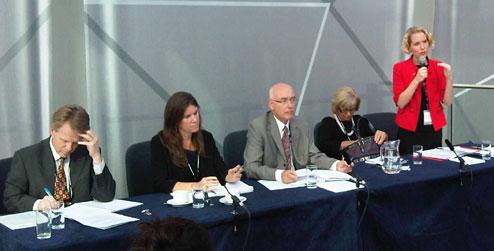
Photo: a BOND sponsored fringe event discussing the labour policy review: from right, Emma Reynolds MP (speaking), Glenys Kinnock, Julian Rush (chair), Clare Melamed (ODI) and Richard Miller (CEO, Action Aid).

